 Suchir
 I build and study small language models trained on developmentally plausible data, in and around the BabyLM Challenge. Under tight budgets each design choice — curriculum, sequence length, supervision signal — becomes measurable, so these models double as scientific instruments for the mechanisms of acquisition. Representative papers: Teacher Demonstrations (ZPD), Best Sequence Length for BabyLM, Less is More, BabyLM Turns 4 (2026 shared task).
Research
Research
From minds to machines: how do intelligent systems learn, represent, and behave? I work across artificial intelligence, cognitive science, and linguistics, using small, human-scale language models as the instrument that lets me watch learning happen.
Overview
Research Agenda
I study how intelligent systems learn, represent, and behave, working across artificial intelligence, cognitive science, and linguistics. Cognitive science and linguistics supply the questions; small language models are the instrument I use to answer them.
How does language shape learning?
Addressing these questions are directly beneficial for the AI community and stakeholders using AI in their systems. My work helps stakeholders build mergeable, efficient small models and agentic pipelines that are cheaper to deploy than frontier systems. More generally, I aim to contribute to the AI community by understanding and building a foundation for multilingual, fairer AI that reaches beyond English into under-served languages and build more human-centered AI that is culturally-adaptive, safe, fair and trustworthy.
I use small language models to study a big question: how does intelligence emerge through learning?
Small models are valuable not because they can compete with large ones, but because their constraints make learning visible, measurable, and interpretable. I study models as epistemic artefacts, focusing on learning dynamics rather than final performance: how representations form, how knowledge transfers, and how learned structure can be recombined. Drawing on machine learning, psychometrics, and developmental psychology, my broader goal is a scientific account of learning across minds and machines.
My PhD tackles four questions:
Can we trace where representations come from?
When can independently trained models be merged without losing what each learned?
Can models learn their own words?
Can segmentation emerge during training, particularly for low-resource languages?
Can small models teach small models?
What determines a machine’s zone of proximal development?
What does scale obscure?
When small models reproduce human-like behaviour, what are they getting right that larger models get wrong?
How do models learn?
Not just what a model knows at the end, but how it gets there — sample-efficiency, the phases of learning, and how post-training shapes behaviour.
I trace how abstractions emerge across training and look inside small models as they develop, drawing on linguistics and cognitive science. I maintain open tooling — PicoLM — so these developmental-interpretability experiments are reproducible for the wider community. Representative papers: Pico, Theoretical Linguistics & Causal Abstraction, Claude reinvestigates herself, Maximising Minimal Means.
I study reinforcement-learning post-training — what constrains exploration under algorithms like GRPO — and alignment objectives inspired by how teachers scaffold learners. Ongoing work includes From Entropy to Exploration: What Limits Post-Training under GRPO? and work on pedagogical alignment. Representative papers: Pedagogical Alignment of LLMs, Protocol Competence of Small LMs.
How does language shape learning?
Languages don't all give a learner the same problem — I study multilingual, bilingual and second-language learning, how text is segmented, and how fairly progress is measured.
My flagship project, Beetle, uses controlled bilingual pretraining to isolate how a second language is acquired and how cross-lingual transfer arises. This connects to multilingual benchmarks and curricula that reach beyond high-resource English into under-served languages. Representative papers: Beetle, BabyBabelLM, BLiSS, L1 Influence in L2 Models, Meta-Pretraining for Cross-Lingual NER, Multimodal Grounding across Languages & Cultures.
I design information-driven ways of splitting text so that learning is more efficient, robust and cross-lingual — grouping predictable bytes dynamically, and studying language-adaptive tokenisation that lets the input representation shift with the language being modelled. Representative papers: ByteSpan, LangMAP, Is Tokenizer Cognitive Plausibility just Fertility?.
Through the xBLiMPs grant and related community work, I develop minimal-pair and grammaticality benchmarks that extend equitable linguistic evaluation to low-resource languages — the infrastructure needed to make fairer multilingual claims credible. Representative papers: BabyBabelLM, Measuring Grammatical Diversity, BLiSS, Phoneme Frequencies across Languages, Phonemes: Chance, Costs & Tiers, Diachronic Phoneme Frequencies, Convergent Phoneme Surprisal.
I study cultural knowledge in pretrained language models — including code-switching and cultural localisation — and argue that the instability of cultural responses is itself informative. Ongoing work includes Repertoires, Not Scores: Instability as Signal in Cultural Evaluation of LLMs. Representative paper: Repertoires, Not Scores.
What representations emerge?
When do independently trained models converge on compatible representations — and do those representations line up with the brain?
I study representation convergence — when independently trained models arrive at compatible representations — and use model merging as a window onto the geometry of what has been learned. Ongoing work includes Mergeability is Constrained by Initialisation, Similarity is not Mergeability, and Representations Bound the Generalizability of Model Merging. Representative papers: Merged Monolingual Goldfish Models, Cross-Lingual Universal Conceptual Representations, Cross-Lingual Alignment Without Joint Training, Linguistic Universals via Sparse Autoencoders.
I study how language-model representations align with the brain across linguistic domains, and use mechanistic interpretability to locate structure inside models — syntactic-agreement units and linear encodings of truth among them. Ongoing work includes Distinct Patterns of Brain Alignment of LMs across Linguistic Domains. Representative papers: Theoretical Linguistics & Mechanistic Interpretability, Claude reinvestigates herself, Linear Truth Encodings, Linguistics in the Age of Language Models.
Can we trust small AI?
Capability is not the same as reliability — I study compact judges, small-model agents, and who a model is actually safe for.
Evaluation is where scientific claims are won or lost. I work on whether small language models can serve as judges, and on the governance and evidence standards for trustworthy compact AI. Ongoing work (NeurIPS 2026 workshops) includes Can We Trust Small Language Models as Judges?, Towards Trustworthy Compact Judges, and Governing the Evidence Standard for Trustworthy Compact AI. Representative papers: Pedagogical Alignment of LLMs, Repertoires, Not Scores.
I work on agentic uses of small LMs that are cheap enough to run on-device, including execution-aware routing and the protocol competence needed for interactive language games. Ongoing work includes Execution-Aware Routing for On-Device SLM Agents and studies of protocol competence in interactive settings. Representative paper: Protocol Competence of Small LMs.
I work on AI safety and governance, with a focus on vulnerable audiences and the gap between recognising risk and acting on it. Ongoing work includes Models Recognise Child Audiences, But Child Safety Does Not Follow and related position papers. Representative papers: Repertoires, Not Scores, Pedagogical Alignment of LLMs.
Applied · Impact
Application areas
The fundamental science radiates outward into three areas of real-world impact, each speaking to a different audience. Tap any card to learn more.
Insights from representation convergence, mergeability and RL post-training translate directly into practical systems: small models that can be composed and merged, and execution-aware agentic pipelines built from efficient small LMs. Relevant to founders, industry teams, and ML researchers looking to build and collaborate.
I develop multilingual models, bilingual pretraining, and evaluation that reaches beyond English to under-served languages — including equitable benchmarks through the xBLiMPs grant — making language technology fairer and more culturally adaptive across the world.
I work on human-centred applications of AI that support learning — teacher-style demonstrations for language learning, culturally grounded evaluation, child-safety, and AI for young people. This ties to public engagement through Per Capita Media, and speaks to social scientists, educators, and policymakers.
Publications
Publications
Papers across artificial intelligence, cognitive science, and linguistics on how intelligent systems learn and behave. Author names in bold indicate my contribution; ✦ marks equal contribution.
Peer-Reviewed Conference & Journal Publications 9
1
Richard Diehl-Martinez, David Demitri Africa, Yuval Weiss, Suchir Salhan, Ryan Daniels, Paula Buttery
EMNLP 2025 Systems Demonstration · Suzhou, China
A modular framework that lets you change one thing in a small language model's architecture or training and directly watch what it does. | Small-model research should be a science, not guesswork.
🟡 5 minutesBuilding small and medium language models is still more art than science: tight parameter budgets make every design choice matter, yet researchers lack systematic ways to test and refine ideas. We introduce Pico, a lightweight, modular framework of two libraries that give researchers a sandbox for making targeted changes to a model's architecture or training procedures and directly observing the effect on its behaviour. To support reproducible experiments, we release a suite of baseline models, pico-decoder, trained under standardised conditions and open-sourced for the community. Case studies show how Pico supports iterative small-LM design and analysis.
2
Jaap Jumelet, Abdellah Fourtassi, Akari Haga, Bastian Bunzeck, Bhargav Shandilya, Diana Galvan-Sosa, Faiz Ghifari Haznitrama, Francesca Padovani, François Meyer, Hai Hu, Julen Etxaniz, Laurent Prévot, Linyang He, María Grandury, Mila Marcheva, Negar Foroutan, Nikitas Theodoropoulos, Pouya Sadeghi, Siyuan Song, Suchir Salhan, Susana Zhou, Yurii Paniv, Ziyin Zhang, Arianna Bisazza, Alex Warstadt, Leshem Choshen
EACL 2026 (Main Conference) · Rabat, Morocco
A multilingual collection of datasets modelling the language a child hears from birth to fluency across 45 languages, with benchmarks and baseline models. | Developmental data has no business being English-only.
🟡 5 minutesWe built BabyBabelLM, a multilingual collection of datasets that model the language a person hears from birth until they acquire a native language. The collection curates developmentally plausible training data of roughly 100 million English word-equivalents across 45 languages. Alongside the data we create evaluation benchmarks and train baseline models. The aim is to support multilingual pretraining research and language acquisition studies.
3
Leshem Choshen, Ryan Cotterell, Mustafa Omer Gul, Jaap Jumelet, Tal Linzen, Aaron Mueller, Suchir Salhan, Raj Sanjay Shah, Alex Warstadt, Ethan Gotlieb Wilcox
BabyLM Workshop 2026 @ EMNLP · Budapest, Hungary
The call for papers for the 2026 BabyLM Workshop, which opens the sample-efficient pretraining challenge up to multilingual training data. | Data-efficient pretraining grows up and stops being English-only.
4
A Computational Operationalisation of Competing Maturational Theories of Syntactic Development via Statistical Grammar Induction
Mila Marcheva, Suchir Salhan, Weiwei Sun
CogSci 2026 (Main Conference), Proceedings of the Annual Meeting of the Cognitive Science Society · Rio de Janeiro, Brazil
Statistical grammar induction over child-directed speech is used to test competing maturational theories of how children's syntax develops. | Grammar induction can adjudicate theories of how syntax matures.
5
Fermín Moscoso del Prado Martín, Suchir Salhan
under review
Macroscopic and microscopic information-theoretic models of how phoneme frequencies are distributed across the world's languages. | The shape of a language's sound system may be predictable from information theory.
6
Fermín Moscoso del Prado Martín, Suchir Salhan
Proceedings of the Society for Computation in Linguistics (SCiL) · Presentation at ACL 2026, San Diego, USA
A model of how the frequency distribution of phonemes emerges over time as languages change. | Today's phoneme frequencies are the fossil record of a language's history.
7
Suchir Salhan, Catherine Arnett, James Michaelov, Paula Buttery
EMNLP 2026 Main Conference · Budapest, Hungary
A suite of bilingual models trained with controlled exposure to a second language, used to model how people process an L2. | Controlling what a model sees, and when, mirrors how humans pick up a second language.
8
LangMAP: A Language-Adaptive Approach to Tokenization
Clara Meister, Suchir Salhan, Andrzej Szablewski, Pietro Lesci, Paula Buttery, Tiago Pimentel
EMNLP 2026 Main Conference · Budapest, Hungary (also Second Tokenization Workshop, COLM)
A tokenisation method that adapts its segmentation to each language rather than applying one fixed scheme everywhere. | One tokeniser for every language leaves performance on the table.
9
Cross-Lingual Alignment Without Joint Training: Do Monolingual Language Models Converge on Universal Representations?
EJ Zhou, Suchir Salhan, Catherine Arnett
EMNLP 2026 Main Conference · Budapest, Hungary
Tests whether language models trained separately on single languages arrive at the same underlying representations without ever sharing training. | If monolingual models converge on their own, the structure is in the languages, not the training.
Peer-Reviewed Workshop Publications 17
1
Salhan, S.A.✦, Diehl-Martinez, Richard, Goriely, Zebulon & Buttery, Paula (2024)
CoNLL 2024 BabyLM Challenge (Paper Track) · Miami, Florida, USA (Nov 2024)
Curricula that follow real theories of child language acquisition, applied language by language, can beat non-curriculum baselines across four language families. | Copy how children actually learn, not just how much.
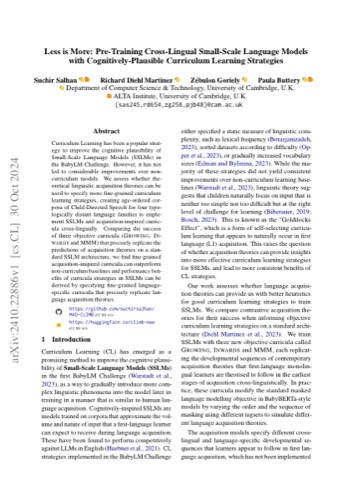
🟡 5 minutesCurriculum learning is a popular way to make Small-Scale Language Models (SSLMs) more cognitively plausible in the BabyLM Challenge, but it has rarely improved much over non-curriculum models. We ask whether theories of linguistic acquisition can specify finer-grained curricula. We build age-ordered corpora of Child-Directed Speech for four typologically distant language families and implement acquisition-inspired curricula cross-lingually. Comparing three curricula that replicate the predictions of acquisition theories (Growing, Inwards and MMM) on a standard SSLM architecture, we find fine-grained, language-specific curricula can outperform non-curriculum baselines.
2
Zebulon Goriely, Suchir Salhan, Pietro Lesci, Julius Cheng, Paula Buttery
ICML 2025 Tokenization Workshop (TokShop) · Vancouver, Canada (August 2025)
ByteSpan builds a subword vocabulary by grouping bytes a language model finds predictable, giving vocabularies that align with morphology better than BPE for English. | Maybe tokenisers should learn morphology, not just compress.
🟡 5 minutesRecent dynamic tokenisers work directly on bytes and pool their latent representations into patches, much like word-segmentation models that mark boundaries where an autoregressive model's prediction error spikes. We ask whether grouping predictable bytes, rather than pooling their representations, can yield a useful fixed subword vocabulary. ByteSpan is an information-driven subword tokeniser that uses an external byte-level LM during training to find contiguous predictable byte sequences and group them into subwords. It produces efficient vocabularies with higher morphological alignment scores than BPE for English, and shows similar compression and Rényi efficiency across 25 languages.
3
Fermín Moscoso del Prado Martín, Suchir Salhan
ACL 2025 Main Conference (Poster) · Vienna, Austria (August 2025)
New information-theoretic measures quantify grammatical diversity from small corpora, staying stable across syntactic annotation scheme and corpus size. | You don't need a huge corpus to measure grammatical richness.
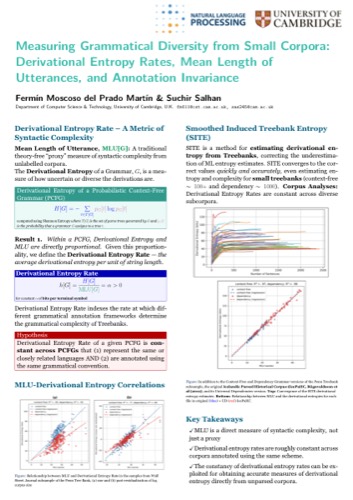
🟡 5 minutesWe introduce information-theoretic measures, derivational entropy rates alongside mean length of utterance, for quantifying grammatical diversity from small corpora. We show the estimates stay robust to the choice of syntactic annotation scheme, a property we call annotation invariance. They also hold up under limited corpus size.
4
David Demitri Africa, Suchir Salhan, Yuval Weiss, Paula Buttery, Richard Diehl-Martinez
5th Workshop on Multilingual Representation Learning (MRL), EMNLP 2025 · Suzhou, China
Adding meta-learning to the pretraining of small decoder models lets them transfer named-entity recognition zero-shot to Philippine languages unseen during training. | Teach small models to adapt and they travel to new languages.
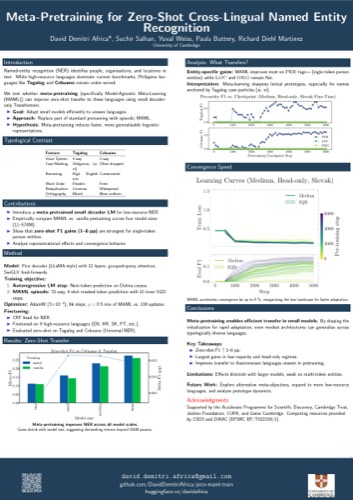
🟡 5 minutesNamed-entity recognition in low-resource languages usually means finetuning very large multilingual LMs, which is often infeasible under memory or latency limits. We ask whether small decoder LMs can be pretrained so that they adapt quickly and transfer zero-shot to languages unseen during pretraining. To do this we replace part of the autoregressive objective with first-order model-agnostic meta-learning (MAML), testing on Tagalog and Cebuano, which are typologically similar yet differ in their actor/non-actor voice systems. Across four model sizes (11M–570M), MAML lifts zero-shot micro-F1 by 2–6 points under head-only tuning and 1–3 points after full tuning, and cuts convergence time by up to 8%. Gains are largest for single-token person entities that co-occur with the Tagalog case particles si and ni.
5
Suchir Salhan, Hongyi Gu, Donya Rooein, Diana Galvan-Sosa, Gabrielle Gaudeau, Andrew Caines, Zheng Yuan, Paula Buttery
BabyLM Workshop, EMNLP 2025 · Suzhou, China
ContingentChat, a Teacher–Student framework, teaches a 100M-word BabyLM to hold more grammatical, cohesive back-and-forth conversation. | Tiny models can learn to actually hold a conversation.
🟡 5 minutesChild–caregiver dialogue has a property called contingency: prompt, direct, meaningful exchanges between the speakers. We introduce ContingentChat, a Teacher–Student framework that benchmarks and improves multi-turn contingency in a BabyLM trained on 100M words. Using a new alignment dataset for post-training, the BabyLM produces responses that are more grammatical and cohesive. Adaptive Teacher decoding strategies give only limited further gains. The work shows targeted post-training helps dialogue quality, and frames contingency as a hard goal for BabyLMs.
6
Bianca-Mihaela Ganescu, Suchir Salhan, Andrew Caines, Paula Buttery
BabyLM Workshop, EMNLP 2025 · Suzhou, China
A lightweight vision-language model with token-wise dynamic gating learns from very little data and leans on images for content words, language for function words. | The model learned when to look, nobody told it to.
.jpg)
🟡 5 minutesTraining vision-language models on cognitively plausible amounts of data means rethinking how models combine words and images. Within the Vision track of the BabyLM Challenge 2025, we propose a lightweight decoder architecture with token-wise dynamic gating for adaptive fusion of linguistic and visual cues, feature modulation and channel attention to stretch limited visual information, and auxiliary contrastive objectives for visual grounding. Across five benchmarks (BLiMP, BLiMP Supplement, EWoK, Winoground and VQA) it matches or beats multimodal baselines. The dynamic gate also discovers interpretable patterns without supervision, favouring visual cues for content words and linguistic cues for function words.
7
Yuan Gao, Suchir Salhan, Andrew Caines, Paula Buttery, Weiwei Sun
BabyLM Workshop, EMNLP 2025 · Suzhou, China
BLiSS is a benchmark of 1.5M minimal pairs built from real learner errors, testing how well second-language small models capture the systematic patterns of learner language. | Learner mistakes are data, not noise.
🟡 5 minutesCross-lingual extensions of the BabyLM Shared Task push Small Language Models to simulate a wider range of acquisition scenarios, including code-switching, simultaneous and successive bilingualism, and second language acquisition. Yet there is no benchmark for the formal competence of cognitively inspired models of L2 acquisition (L2LMs). We introduce the Benchmark of Learner Interlingual Syntactic Structure (BLiSS): 1.5M naturalistic minimal pairs derived from errorful sentence–correction pairs in parallel learner corpora. We use them to evaluate L2LMs trained under different regimes on specific properties of learner language, giving a linguistically motivated, controlled measure of interlanguage competence.
8
Suchir Salhan, Richard Diehl-Martinez, Zebulon Goriely, Paula Buttery
BabyLM Workshop, EMNLP 2025 · Suzhou, China
For BabyLM pretraining, longer context often helps but not always: short sequences suffice for grammar tasks, while morphological reasoning benefits from longer ones. | There is no single best context length; it depends on the task.
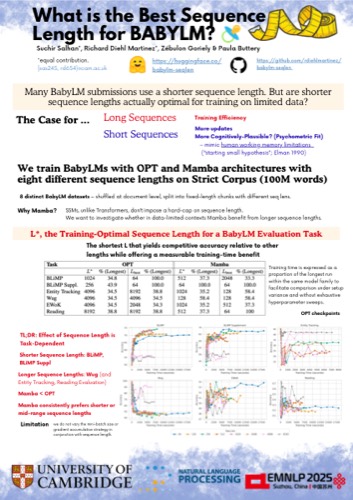
🟡 5 minutesTransformer language models use a fixed context window that has grown in step with pretraining dataset size, yet many BabyLM submissions default to much shorter sequences. We ask a simple question: what sequence length should we use when training BabyLMs? Using 100M words of training data and fixed compute budgets, we compare 125M-parameter Mamba and OPT models. Longer is often better, but the best length depends on both task and architecture. Shorter sequences are enough for grammatical generalization, while longer contexts help morphological analogical reasoning.
9
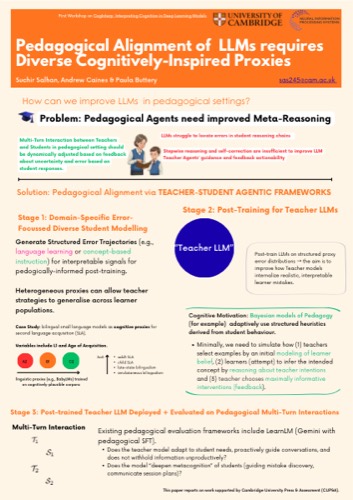
Pedagogical Alignment of LLMs Requires Diverse Cognitively-Inspired Student Proxies
Suchir Salhan, Andrew Caines, Paula Buttery
NeurIPS First Workshop on CogInterp: Interpreting Cognition in Deep Learning Models, 2025 · San Diego, California, USA
Argues that aligning tutoring models to learners needs a diverse set of cognitively-inspired student simulators, not one generic proxy. | A tutor trained against one imaginary student teaches only that student.
10
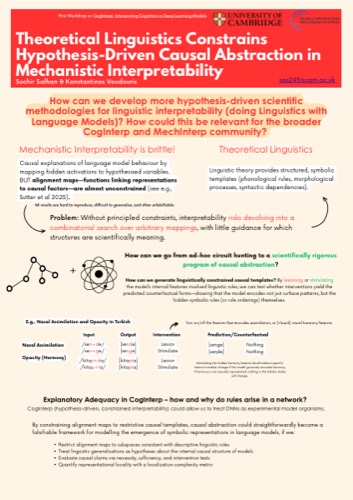
Theoretical Linguistics Constrains Hypothesis-Driven Causal Abstraction in Mechanistic Interpretability
Suchir Salhan, Konstantinos Voudouris
NeurIPS First Workshop on CogInterp: Interpreting Cognition in Deep Learning Models, 2025 · San Diego, California, USA
Uses theoretical linguistics to constrain which causal abstractions are worth testing in mechanistic interpretability. | Linguistic theory tells interpretability where to look.
11
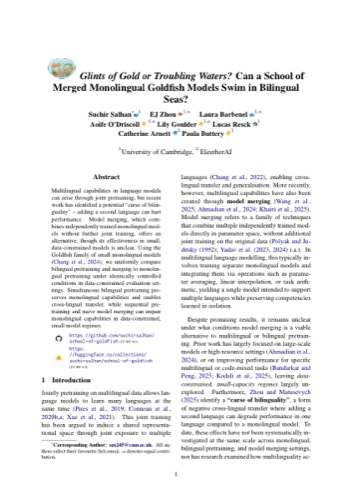
Glints of Gold or Troubling Waters? Can a School of Merged Monolingual Goldfish Models Swim in Bilingual Seas?
Suchir Salhan, EJ Zhou, Laura Barbenel, Lily Goulder, Lucas Resck, Catherine Arnett & Paula Buttery
EACL Workshop on Multilingual Multicultural Evaluation (MME), Non-Archival Full Paper, 2026 · Rabat, Morocco
Asks whether merging separately trained monolingual Goldfish models produces a working bilingual model.
12
Do Monolingual Language Models Learn Cross-Lingual Universal Conceptual Representations?
Suchir Salhan, EJ Zhou & Paula Buttery
ICLR Workshop on Unifying Concept Representation Learning (UCRL) & ICLR Workshop on Representational Alignment (Re-Align), 2026 · Rio de Janeiro, Brazil
Probes whether models trained on a single language nonetheless build concept representations that line up across languages. | Shared concepts can show up even without shared training data.
13
L1 Influence in L2 Language Models: A Human-Centric Approach
Laura Barbenel, Lily Goulder, Aoife O'Driscoll, Suchir Salhan, Catherine Arnett, Andrew Caines & Paula Buttery
Computational Developmental Linguistics (CDL) Workshop @ ACL 2026
A human-centred study of how a model's first language shapes its behaviour when it goes on to learn a second. | Models carry an accent from their first language, much like people do.
14
Repertoires, Not Scores: Instability as Signal in Cultural Evaluation of LLMs
Suchir Salhan, Filip Trhlik, Diana Galvan-Sosa & Paula Buttery
Culture x AI Workshop, ICML 2026 · Seoul, Korea
Argues that the instability in an LLM's cultural responses is itself the signal, so evaluation should report repertoires rather than single scores. | A model's cultural variation is data, not measurement error.
15
Protocol Competence of Small Language Models in Interactive Language Game Environments
Suchir Salhan, Paula Buttery
The LM Playschool (Improving Language Models through Learning from Dialogue Interaction) @ EMNLP 2026 · Budapest, Hungary
Tests whether small language models can follow the protocols of interactive language games learned through dialogue. | Playing language games is a demanding test of a small model's competence.
16
Claude reinvestigates herself: A replication of different types of syntactic agreement recruit the same units in LLMs
Elena Polyakova-Reed, Shivan Arora, Suchir Salhan, Paula Buttery
9th BlackboxNLP Workshop Special Track (Reproducibility & Reliability), EMNLP 2026 · Budapest, Hungary
A replication asking whether different kinds of syntactic agreement are handled by the same units inside an LLM. | Does one grammar circuit do many jobs? Replication puts it to the test.
17
Development of Linear Truth Encodings in Language Models: A Replication Study
Mingchuan Zou, Suchir Salhan, Paula Buttery
9th BlackboxNLP Workshop Special Track (Reproducibility & Reliability), EMNLP 2026 · Budapest, Hungary
Replicates how linear representations of truth emerge in language models over the course of training. | When does a model start encoding true-vs-false as a direction you can read off?
Working Papers 7
1
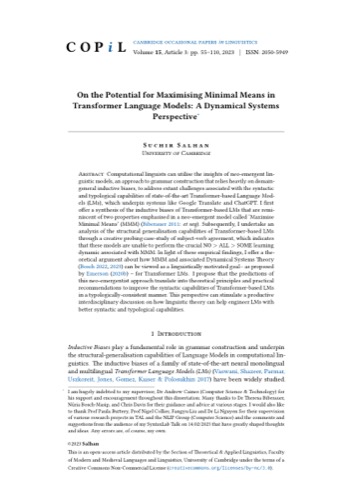
Salhan, S.A.✦ (2023)
Cambridge Occasional Papers in Linguistics, Volume 15, Article 3: pp. 55–110. ISSN: 2050-5949
A dynamical-systems reading of Transformer language models through the linguistic principle of maximising minimal means. | Efficiency principles from linguistics can describe what Transformers do.
2
Multimodal Language Modelling across Languages and Cultures: Grounding Strategies for Nouns and Verbs
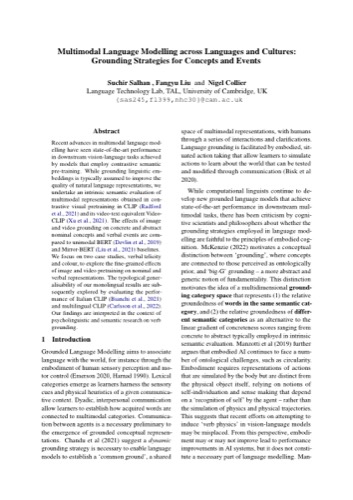
Suchir Salhan, Fangyu Liu & Nigel Collier (2022 / preprint)
Research Project, Language Technology Lab, Department of Theoretical and Applied Linguistics, University of Cambridge
Compares grounding strategies for nouns and verbs when modelling language across languages and cultures with images. | Nouns and verbs don't ground in images the same way.
3
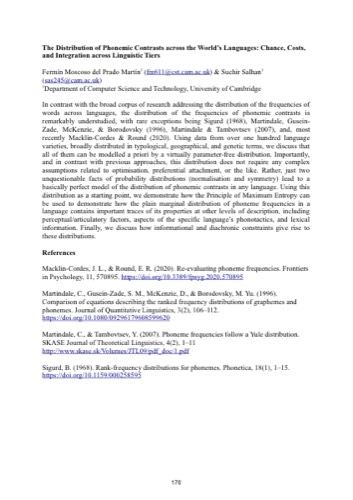
The Distribution of Phonemes across Languages: Chance, Costs, and Integration across Linguistic Tiers
Fermín Moscoso del Prado Martín, Suchir Salhan (2026)
23rd Old-World Conference in Phonology (OCP23), Gonville & Caius College (Accepted Oral)
Examines how phoneme distributions across languages reflect chance, articulatory cost, and integration across linguistic tiers. | A sound system balances what's easy to say against what's easy to tell apart.
4
Convergent Equilibria in Cross-Lingual Phoneme Surprisal Distributions: Statistical and Simulation-Based Analysis
Suchir Salhan, Fermín Moscoso del Prado Martín (2026)
23rd Old-World Conference in Phonology (OCP23), Gonville & Caius College (Accepted Oral)
Statistical and simulation-based analysis of whether phoneme surprisal distributions settle into the same equilibrium across languages. | Different languages may drift toward the same statistical resting point.
5
EJ Zhou, Suchir Salhan
5th Workshop on Multilingual Representation Learning (MRL), EMNLP 2025 · Suzhou, China
Aligns sparse-autoencoder features across separately trained monolingual models to look for universal features that emerge independently. | Languages may share structure that models rediscover on their own.
🟡 5 minutesDo independently trained monolingual language models converge on shared linguistic principles? We analyse a suite of models trained separately on single languages with identical architectures and budgets. We train sparse autoencoders on their activations to get interpretable latent features, then align those features across languages using activation correlations. Pairwise analyses test whether the feature spaces converge in non-trivial ways, and we look for universal features that recur across models.
6
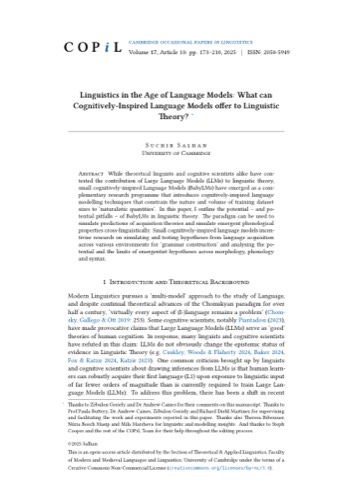
Linguistics in the Age of Language Models: What can Cognitively-Inspired Language Models offer to Linguistic Theory?
Salhan, S.A. (2025)
Position Paper in Cambridge Occasional Papers in Linguistics (CoPiL), Accepted, Volume 17
A position paper on what cognitively-inspired language models can offer linguistic theory. | Language models can be evidence for linguistics, not just tools built from it.
7
Is Tokenizer Cognitive Plausibility just Fertility?
Suchir Salhan
Extended Abstract, Second Tokenization Workshop, Conference of Language Modelling (COLM) · San Francisco, USA
Asks whether what looks like cognitive plausibility in a tokenizer reduces to fertility (how many tokens it uses). | Maybe the tokenizer's "plausibility" is just counting tokens.